Integrating ISO 27001 with GRC: From Compliance to Competitive Advantage
In an era where data breaches dominate headlines and regulatory landscapes evolve rapidly, organizations can no longer treat information security as a standalone IT issue. ISO 27001, the internationally recognized standard for establishing, implementing, maintaining, and continually improving an Information Security Management System (ISMS), has become essential. Yet, certification alone is not a silver bullet.
To unlock its full value, businesses must integrate ISO 27001 into a broader Governance, Risk, and Compliance (GRC) strategy—turning static controls into dynamic, business-aligned processes.
The Limitations of a Siloed ISO 27001 Implementation
For many organizations, ISO 27001 implementation is treated as a project led by IT or security teams, often under pressure to “get certified” to win customer trust or meet procurement requirements. This approach, while well-intentioned, introduces several inefficiencies:
-
Siloed Controls: Security controls exist in isolation from enterprise risk and compliance programs.
-
Manual Workflows: Evidence collection, control validation, and risk assessments become time-consuming, error-prone tasks.
-
Redundant Effort: Controls are duplicated across ISO 27001, SOC 2, NIST, HIPAA, and other frameworks.
-
Audit Fatigue: Each audit cycle feels like starting from scratch, lacking institutional memory or reuse.
-
Lack of Strategic Context: ISO initiatives rarely connect to business KPIs or board-level metrics.
By integrating ISO 27001 into a unified GRC platform, organizations can streamline these efforts and create a culture of security-by-design.
GRC-Driven Enhancements for ISO 27001 Compliance
A modern GRC platform enables you to transform ISO 27001 from a checklist into a living, evolving capability. Here’s how:
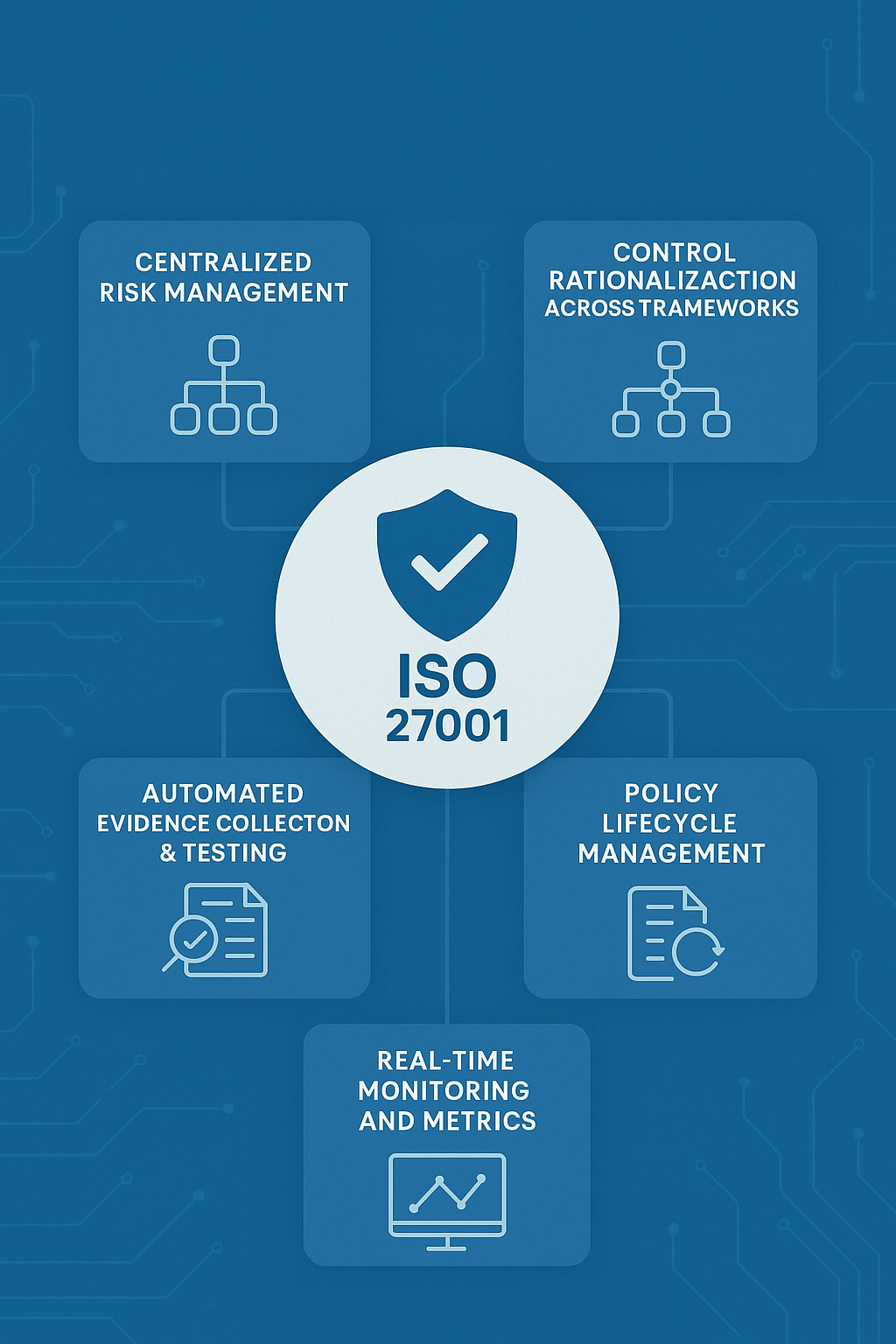
1. Centralized Risk Management
ISO 27001 requires organizations to identify and treat information security risks. GRC platforms allow you to link these risks directly to your enterprise risk register, improving visibility and prioritization. This ensures the most critical threats are mitigated with appropriate controls—aligned with both ISO and business objectives.
2. Control Rationalization Across Frameworks
ISO 27001 shares many control requirements with other frameworks like NIST CSF, SOC 2, and PCI-DSS. GRC systems enable cross-framework control mapping, so a single control implementation can satisfy multiple obligations, reducing overhead.
3. Automated Evidence Collection & Testing
Traditional ISO 27001 audits demand extensive manual evidence gathering. GRC platforms automate this by pulling data from integrated systems (e.g., ticketing, HR, identity management), running control tests, and storing audit logs in real-time.
4. Policy Lifecycle Management
ISO 27001 mandates that organizations establish, communicate, and review policies. With GRC tools, policy versioning, approvals, distribution, and training tracking can all be automated—closing the loop between documentation and enforcement.
5. Real-Time Monitoring and Metrics
Dashboards allow stakeholders to monitor ISO 27001 control effectiveness, non-conformities, corrective actions, and overall compliance posture. This empowers proactive remediation and executive visibility
The WinGRC Approach to ISO 27001 Integration
At WinGRC, we help organizations evolve from isolated compliance programs to integrated, risk-aligned systems. Whether you’re preparing for your first ISO 27001 audit or looking to automate a mature program, our approach ensures results are sustainable, auditable, and strategically aligned.
Here’s how WinGRC makes a difference:
Unified Controls Library
We map ISO 27001 Annex A controls into a common control framework. This reduces duplication and allows evidence reuse across certifications.
Workflow-Driven Implementation
Our GRC platform enables role-based responsibilities, automated review cycles, and seamless cross-team collaboration.
Integration-Ready Architecture
Whether you’re using Jira, Confluence, Microsoft 365, Okta, or ServiceNow, WinGRC integrates with your systems to collect and validate compliance data in real time.
ISO Readiness Assessments
We offer automated gap analysis tools and readiness scoring to assess your ISO maturity before engaging with external auditors.
Continuous Improvement Engine
ISO 27001 is not a one-time event—it’s a lifecycle. We support continuous improvement through recurring risk reviews, policy refreshes, and training audits.
Conclusion: The Future of Security Lies in Integration
The organizations that thrive in today’s environment are those that embrace security as a business enabler—not just a checkbox.
By integrating ISO 27001 with your GRC program, you shift from reactive compliance to proactive risk management. You gain clarity across your organization, efficiency in your audits, and confidence in your controls. And with partners like WinGRC, you don’t walk that journey alone.
We help you build the foundation—and scale it—so that your security and compliance programs grow with your business.