Mastering Cloud Risk Management Strategy with Win GRC
In an era where cloud adoption is accelerating at an unprecedented pace, organizations must strike a balance between innovation and security. The cloud offers unmatched flexibility and scalability but it also introduces new layers of risk, from data breaches and compliance failures to misconfigured resources and third-party vulnerabilities. To navigate this complex environment, a well-defined cloud risk management strategy is no longer optional—it’s essential. This blog explores the core elements of an effective strategy and how Win GRC empowers organizations to secure their cloud environments while maintaining regulatory compliance and operational resilience.
Understanding Cloud Risk Management
Cloud Risk Management is the process of identifying, assessing, and controlling risks related to the use of cloud computing services. As organizations increasingly adopt cloud platforms such as Infrastructure as a Service (IaaS), Platform as a Service (PaaS), and Software as a Service (SaaS)—the landscape of potential risks expands, requiring specialized governance and oversight. Unlike traditional IT environments, the cloud introduces new complexities, including shared responsibility models, dynamic resource allocation, and third-party vendor dependencies. Effective cloud risk management ensures that an organization can safely leverage the benefits of cloud technology—such as scalability, cost savings, and flexibility—while minimizing threats to data security, privacy, and regulatory compliance.
-
Risk Identification: Understanding what threats exist specifically in the cloud, such as data leakage, unauthorized access, and misconfigurations.
-
Risk Assessment: Evaluating the likelihood and impact of identified risks on business operations and compliance.
-
Mitigation Controls: Implementing safeguards such as encryption, access controls, identity and access management (IAM), and continuous monitoring.
-
Compliance Alignment: Ensuring cloud operations meet industry and regulatory standards like GDPR, HIPAA, PCI-DSS, and ISO 27001.
-
Incident Response Planning: Preparing for and managing cloud security incidents to reduce downtime and data loss.
With a comprehensive cloud risk management approach, organizations can confidently adopt cloud technologies while protecting their critical assets and maintaining trust with customers and stakeholders.
Understanding Cloud-Specific Risks
Cloud computing introduces a range of risks that differ from traditional on-premise environments. These risks arise due to the shared, dynamic, and decentralized nature of cloud infrastructures. Failing to recognize and manage these risks can lead to data loss, non-compliance, or operational disruption.
Key cloud-specific risks include:
-
Data Exposure Through Misconfigurations
Cloud services often come with default settings that, if not configured properly, can expose sensitive data to the public internet. -
Insecure Interfaces and APIs
Cloud platforms rely heavily on APIs. If these are not securely designed and managed, they become prime targets for attackers. -
Shared Responsibility Model Confusion
Cloud providers and customers share security responsibilities, but many organizations misunderstand where their duties begin and end. -
Unauthorized Access
Without strong identity and access management, cloud resources can be accessed by malicious insiders or external actors. -
Data Residency and Compliance Challenges
Storing data across borders can trigger regulatory conflicts and data sovereignty concerns. -
Limited Visibility
Monitoring and controlling assets across multiple cloud platforms can be challenging, leading to blind spots in security and compliance.
Recognizing these unique risks is essential to building a targeted cloud risk management strategy that protects both business operations and customer trust.
Core Components of a Cloud Risk Management Strategy
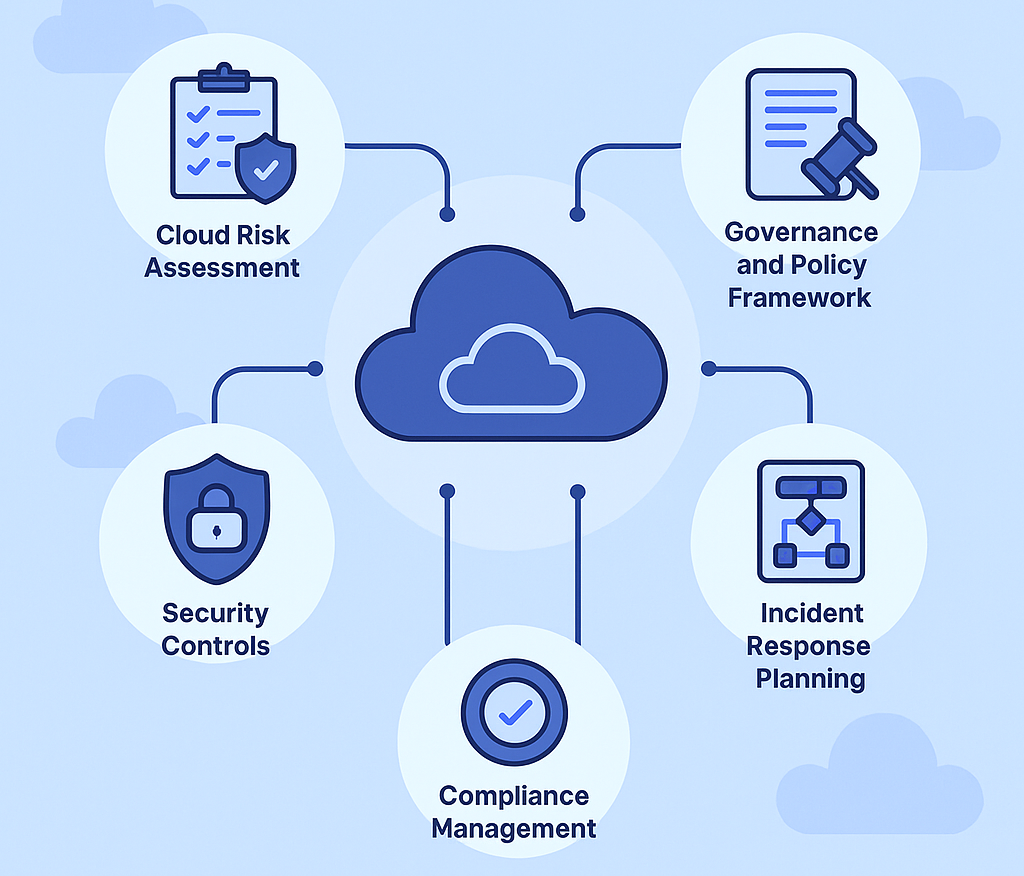
A successful cloud risk management strategy is built on a foundation of proactive planning, continuous oversight, and alignment with business and compliance goals. Organizations must take a structured approach to manage the dynamic nature of cloud environments and the evolving threat landscape.
-
Cloud Risk Assessment: Identify assets, evaluate threats and vulnerabilities, and assess potential impacts.
-
Governance and Policy Framework: Establish clear policies around cloud usage, data handling, and access control.
-
Security Controls: Implement encryption, identity and access management (IAM), firewalls, and continuous monitoring.
-
Compliance Management: Ensure alignment with frameworks like ISO 27001, NIST, GDPR, or HIPAA.
-
Incident Response Planning: Prepare for cloud-related breaches with a defined response and recovery protocol.
Common Challenges in Cloud Risk Management
While many organizations develop strategies to manage cloud risk, there are persistent challenges that are often underestimated or overlooked. These pitfalls can significantly weaken an organization’s security posture and increase the likelihood of data breaches, compliance failures, and operational disruptions.
Lack of Visibility into Multi-Cloud Environments
Many organizations rely on multiple cloud providers (e.g., AWS, Azure, Google Cloud) for different services. However, each platform has its own monitoring and security tools, which makes it difficult to get a unified view of all risks. This fragmented visibility leads to gaps in monitoring, inconsistent policies, and blind spots that attackers can exploit.
Shadow IT and Unsanctioned Tools
Employees often use third-party cloud apps or services without formal IT approval. These tools—known as “shadow IT”—bypass governance and are rarely secured or monitored, increasing the risk of data leakage, non-compliance, and unauthorized access.
Misconfigured Cloud Storage and Services
Simple configuration errors—like open Amazon S3 buckets, unsecured databases, or overly permissive firewall rules—are a top cause of cloud data breaches. These mistakes often happen because of manual setups, unclear responsibilities, or lack of security automation.
Inconsistent Access and Identity Management
In many cloud setups, user roles, permissions, and access policies are not regularly reviewed or standardized. This increases the risk of privilege escalation, insider threats, or data exposure due to unauthorized access.
Siloed Risk, Compliance, and Security Tools
Using separate tools for risk assessments, compliance tracking, and security monitoring leads to duplicated efforts, disconnected workflows, and inconsistent reporting. This fragmentation makes it difficult to prioritize risks or demonstrate compliance efficiently.
These challenges highlight the need for a more integrated and automated approach to managing cloud risks—one that brings visibility, control, and accountability under a unified GRC framework.
Empowering Seamless Cloud Risk Management with Win GRC
In today’s fast-evolving digital landscape, managing cloud risk demands more than just isolated tools and manual processes. Organizations need an intelligent, unified approach that can adapt to the complexities of multi-cloud environments, regulatory expectations, and ever-changing threats. Win GRC simplifies this challenge by providing an integrated platform that brings together visibility, governance, and compliance into one seamless experience.
With Win GRC, organizations gain real-time insight into cloud assets and activities across platforms like AWS, Azure, and Google Cloud. Instead of struggling with fragmented monitoring and reactive risk handling, teams can proactively identify misconfigurations, unauthorized access, and compliance gaps as they occur. Automated risk assessments and smart alerts ensure that issues are addressed promptly before they escalate into security incidents or audit failures. What sets Win GRC apart is its ability to transform complex regulatory requirements into clear, actionable controls. Whether aligning with ISO 27001, GDPR, HIPAA, or industry specific mandates, compliance becomes a continuous, low-effort process. Governance improves as policy enforcement and access control are streamlined across cloud services, reducing the chance of oversight or inconsistency.
By consolidating cloud risk, compliance, and third-party oversight into a single dashboard, Win GRC enables business leaders, IT teams, and risk officers to collaborate more effectively. It turns cloud risk management from a siloed obligation into a strategic advantage empowering organizations to operate with confidence, resilience, and clarity in the cloud.
The Future of Cloud Risk Management
Cloud risk management is rapidly evolving to meet the demands of increasingly complex environments and sophisticated threats. The future will focus on intelligent automation, continuous compliance, and integrated governance, enabling organizations to stay ahead of risks while simplifying operations.
-
AI-driven Risk Detection: Leveraging artificial intelligence to predict and identify potential vulnerabilities before they escalate.
-
Automated Policy Enforcement: Real-time correction of misconfigurations and enforcement of compliance controls without manual intervention.
-
Continuous Compliance Monitoring: Ongoing adherence to regulatory requirements, reducing audit cycles and improving transparency.
-
Unified Multi-Cloud Governance: Centralized visibility and management across diverse cloud platforms and service providers.
-
Integrated GRC Solutions: Platforms like Win GRC delivering end-to-end risk, compliance, and governance management under one roof.
-
Strategic Risk Management: Transitioning from reactive risk responses to proactive, business-aligned risk strategies.
Conclusion: Transforming Cloud Risk into Strategic Advantage
Effectively managing cloud risk is critical to safeguarding your organization’s digital assets and ensuring compliance in an ever-changing environment. As cloud ecosystems grow more complex, relying on fragmented tools and manual processes is no longer viable. Win GRC offers a comprehensive, integrated platform that simplifies cloud risk management through automation, real-time visibility, and continuous compliance. By adopting Win GRC, organizations can transform cloud risk from a challenge into a strategic advantage—building resilience, agility, and trust. Investing in intelligent cloud risk management today ensures your organization is prepared for tomorrow’s risks and opportunities.