Transforming GRC with AI: Smarter Governance, Risk, and Compliance
In today’s rapidly evolving landscape of heightened regulatory demands, growing risk factors, and constrained compliance resources, organizations are increasingly in search of innovative strategies to effectively navigate governance, risk, and compliance GRC frameworks. Rather than viewing Artificial Intelligence AI as a mere substitute for GRC professionals, it should be embraced as a formidable ally that enhances their capabilities and empowers them to tackle challenges with greater efficiency and insight.
The GRC Landscape: A Growing Challenge
GRC programs today are expected to operate in real time, across siloed departments, and with complete audit readiness. Unfortunately, many companies still rely on spreadsheets, static policies, and manual evidence collection—introducing inefficiencies and vulnerabilities.
AI steps in to solve this. It brings:
-
Real-time analytics and alerts
-
Continuous compliance checks
-
Predictive insights for emerging risks
Where AI Adds Value Across GRC Functions
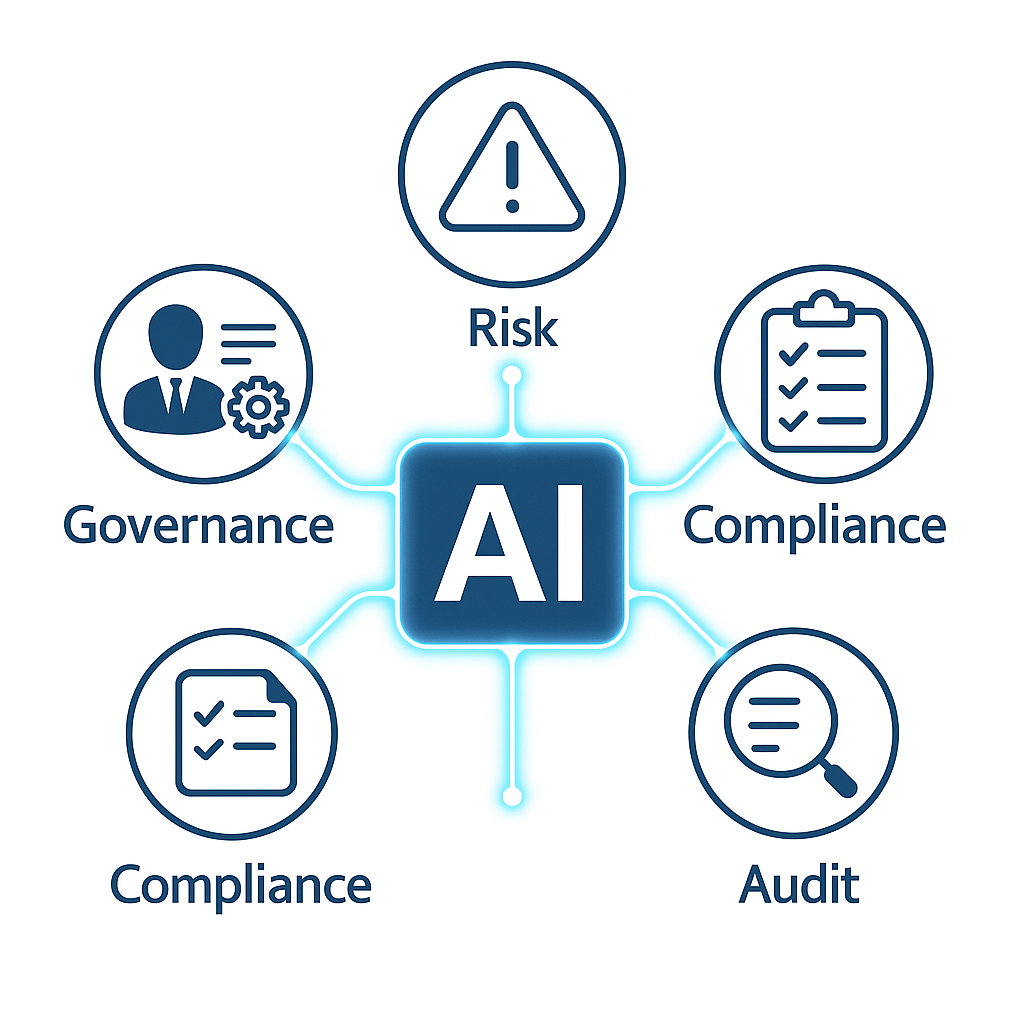
Governance:
AI, particularly Natural Language Processing (NLP), enhances governance by automating the review, classification, and version control of internal policies and procedures. It ensures that documents stay aligned with regulatory expectations, flags outdated policies, and can detect inconsistencies or gaps in organizational workflows—supporting better decision-making and accountability across departments.
Risk:
Machine learning models analyze historical and real-time data to generate predictive risk scores, identify emerging threats, and detect deviations from expected patterns. This enables proactive risk management by surfacing issues before they become incidents, prioritizing risk mitigation efforts, and adapting to evolving operational environments with greater agility.
Compliance:
AI automates time-consuming compliance tasks such as evidence collection, control testing, and mapping controls to frameworks (like SOC 2, ISO 27001, or HIPAA). It reduces manual effort by pulling data directly from source systems, validating it against compliance requirements, and ensuring traceability—all while keeping records audit-ready and up to date.
Audit:
With AI, organizations can move from periodic audits to continuous assurance. Tools equipped with AI can monitor logs, detect anomalies, and highlight transactions that deviate from expected behavior. This allows internal audit teams to focus on higher-value analysis while increasing the accuracy, frequency, and effectiveness of their reviews.
AI Across Frameworks: Augmenting Assurance
AI amplifies compliance efforts tied to frameworks, including:
-
SOC 2: Automates control evidence, questionnaire responses
-
ISO 27001: Flags misaligned controls; accelerates internal audits
-
HIPAA: Detects potential PHI exposure in log and messaging data
-
NIST CSF: Enhances Identify, Detect, and Respond functions with intelligent monitoring
AI doesn’t replace the rigor of frameworks—it enhances how they’re applied and maintained.
Introducing Win GRC: GRC That Scales With You
At Win GRC, we help businesses embed AI strategically across their GRC stack—without losing audit integrity or control. Our team brings cross-domain expertise in compliance, security engineering, and automation tooling.
Our AI-Enabled GRC Services:
-
AI-assisted classification of compliance artifacts
-
Smart mapping of policies to framework controls
-
Chatbots for faster vendor risk management
-
Evidence extraction and tagging across systems (cloud, endpoint, workflow)
Every engagement starts with alignment to your business and regulatory context—and scales responsibly from there.
The Win GRC Difference
We deliver AI solutions with guardrails:
-
Risk-Literate Design: AI only where business and compliance maturity allow
-
Framework-Mapped Logic: Every recommendation ties back to SOC 2, ISO, HIPAA, etc.
-
Platform-Agnostic Integration: Workflows that plug into your tools—Jira, Confluence, Notion, custom APIs
-
Human Oversight: Our “AI+Expert” model ensures transparency and audit readiness
Looking Ahead: GRC with Embedded Intelligence
The future of GRC isn’t just automation—it’s augmentation. Examples include:
-
Real-time evidence pull from production environments
-
Auto-generated audit reports with supporting control data
-
Embedded compliance “co-pilots” within internal portals
-
Predictive risk dashboards for execs based on live telemetry
Final Thoughts
AI is not a silver bullet—but it’s a strategic asset for companies serious about scalable, resilient GRC.
At Win GRC, we help you adopt AI that fits your frameworks, risk posture, and business goals. The result? Less time on checklists, more time on meaningful risk management.